English
 Português
 Español

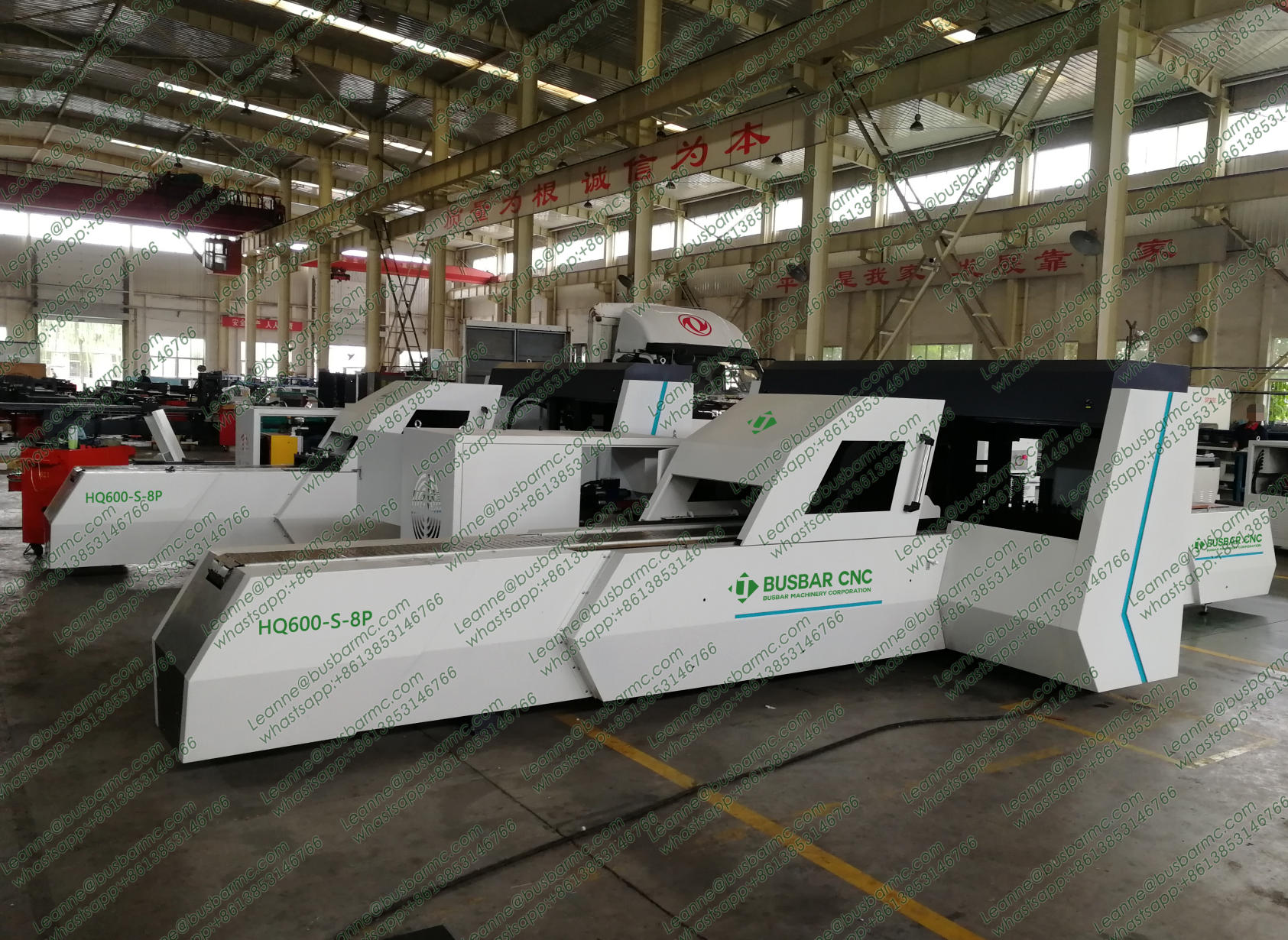
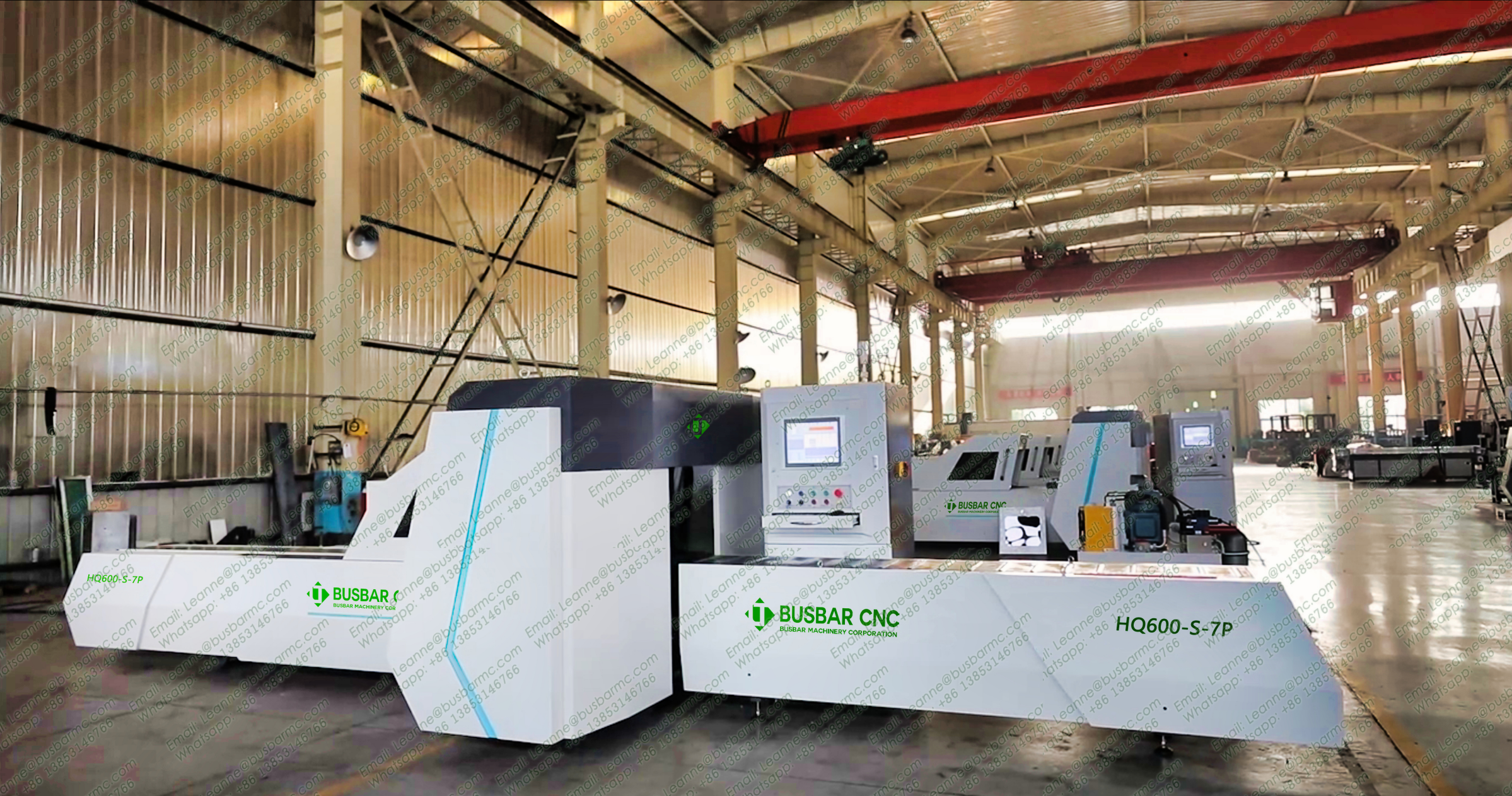
Quick answer: busbar punching quality is judged by finished hole position from the approved drawing datum, size or profile, edge distance, burr and deformation, not by a brochure positioning-accuracy claim. On LT 303U-3-C, 503U-3-C and 803U-3-C machines, a multi-station turret and adequate tonnage cover common round and oblong families when the die, clearance and stripper match copper or aluminum and its temper.
Define accuracy before you set up
In a shop that builds switchboards to IRAM and IEC 61439, the hole has to match terminals, insulators and links. Agree the datum, position tolerance, hole set (round, oblong or other) and burr criterion before FAT. An illustrative pass/fail is edge burr and deformation, not diameter alone.
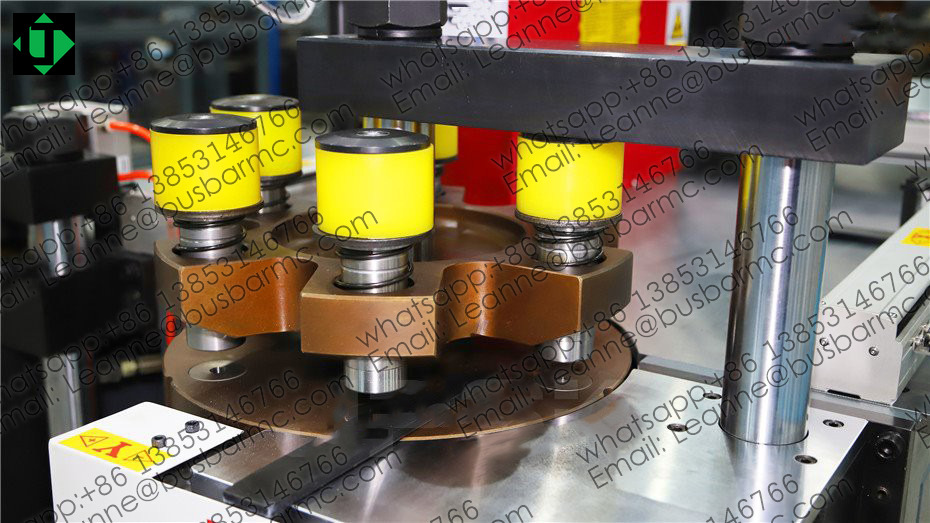
Dies, clearance and turret practice
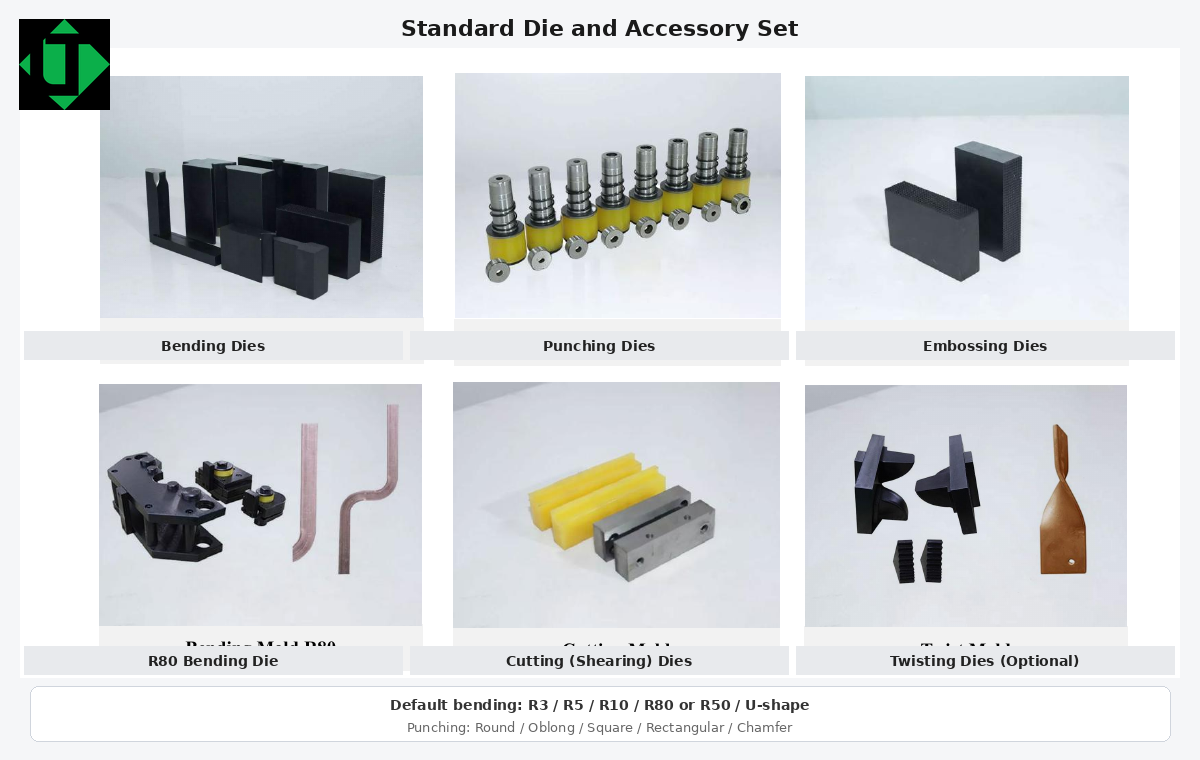
Select dies for the actual material, temper, thickness and profile. Illustrative starter families (confirm on order): round Ø7, Ø9, Ø11, Ø13 and Ø17; oblong Ø11×15, Ø13×18 and Ø17×21. Published punching ranges are 303 Φ4.3–Φ25, 503 Φ4.3–Φ30 and 803 Φ4.3–Φ34 mm. Clearance and stripper must match thickness; wrong clearance increases burr and can oval the hole.
Positioning: manual stop vs servo / CNC
A manual stop can suffice on short runs. Servo or CNC positioning reduces scatter when the same busbar kit repeats, which is common on distribution switchboards built in Buenos Aires, Córdoba or Rosario. In all cases, final quality is the hole in the part, not the display reading.
Model capacity for punching
| Model | Nominal force (kN) | Punching diameter (mm) | Max thickness / width (mm) | Max horizontal bend (mm) | Max vertical bend (mm) | Pump power |
|---|---|---|---|---|---|---|
| 303U-3-C | 300 | Φ4.3–Φ25 | 12 / 150 | 150 / 12 | 10×100 | 3×4 kW |
| 503U-3-C | 500 | Φ4.3–Φ30 | 16 / 200 | 200 / 16 | 12×120 | 3×5.5 kW |
| 803U-3-C | 800 | Φ4.3–Φ34 | 20 / 250 | 250 / 20 | 12×120 | 3×5.5 kW |
Figures come from the public LT / LTMC tables for 303U-3-C, 503U-3-C and 803U-3-C. Thickness class must always be confirmed together with width, hole and bend geometry, and FAT samples. Published angle tolerance: ±1° / ±0.5° (verify on the offer and FAT). Usual export voltage: 380 V / 50 Hz; other voltages (400 V 60 Hz, 415 V 50 Hz, 220 V 60 Hz) are declared on the order. Argentine workshops typically run 380 V / 50 Hz.
FAT checks for punched busbars
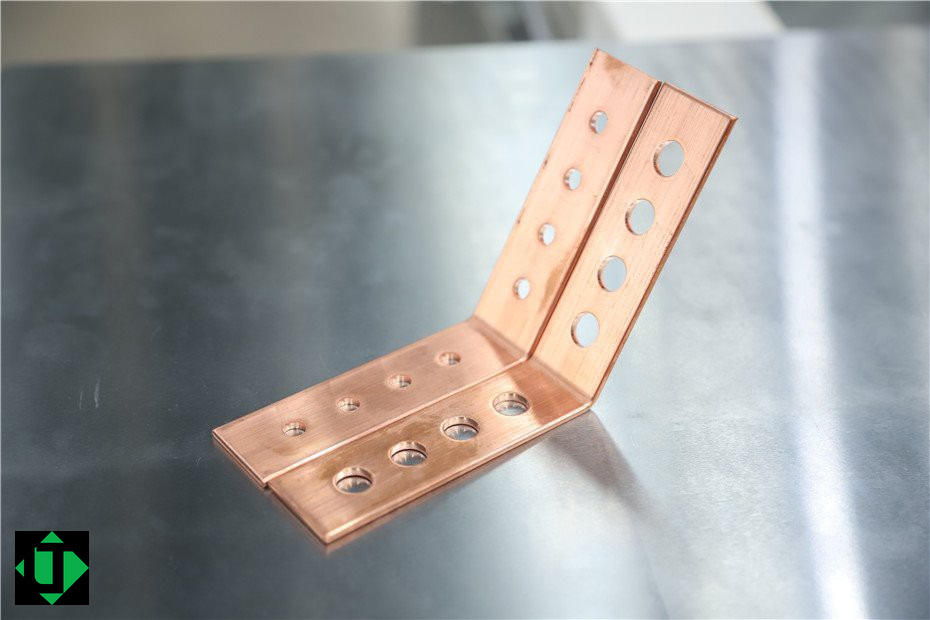
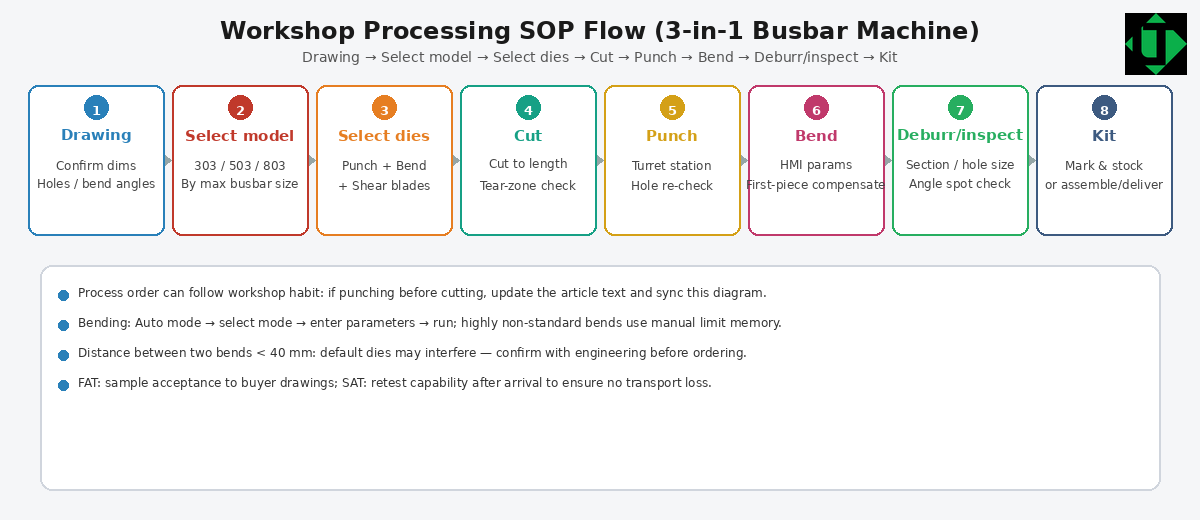
At FAT, measure position from the datum, diameter or profile, edge distance and burr, on a short run (first, middle and last). The usual shop flow is drawing, cut, punch, bend and inspect.
Frequently asked questions
What decides hole accuracy?
The drawing datum, die alignment, clearance, stripper, enough tonnage and repeatable positioning.
Can the same turret punch copper and aluminum?
Yes, if clearance, stripper and wear are reviewed. Do not assume a copper-only approved set is valid.
Round vs oblong dies?
The switchboard drawing decides. Oblong holes are common for joint adjustment; confirm the family on the order.
Where does punching sit on a 3-in-1?
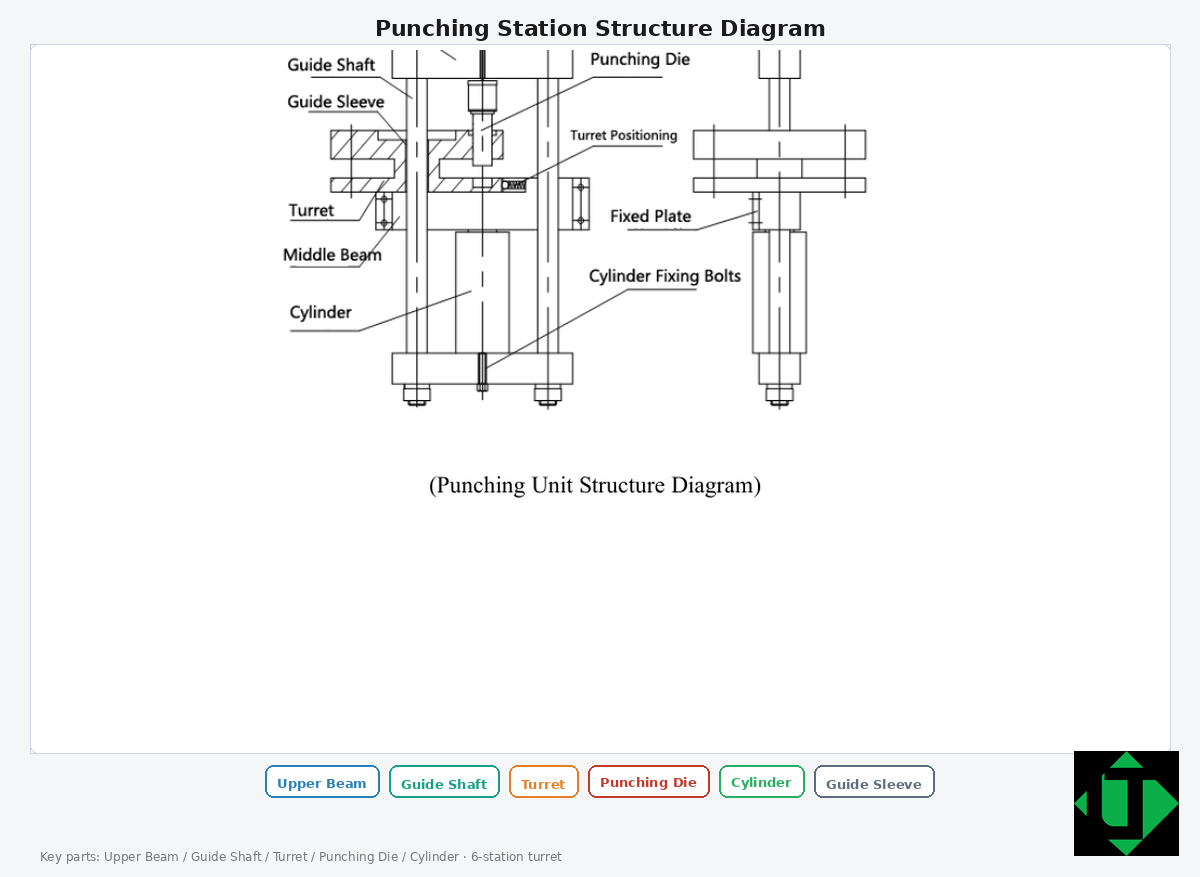
It is one of the three stations on the frame, with its own pump, alongside cut and bend.
How to request a quotation
For a quotation, send drawings, material (copper or aluminum and temper), maximum width × thickness, the hole and bend list, tolerances and supply voltage to [email protected] or WhatsApp +86 13853146766. More information: https://www.busductmachine.com/.